
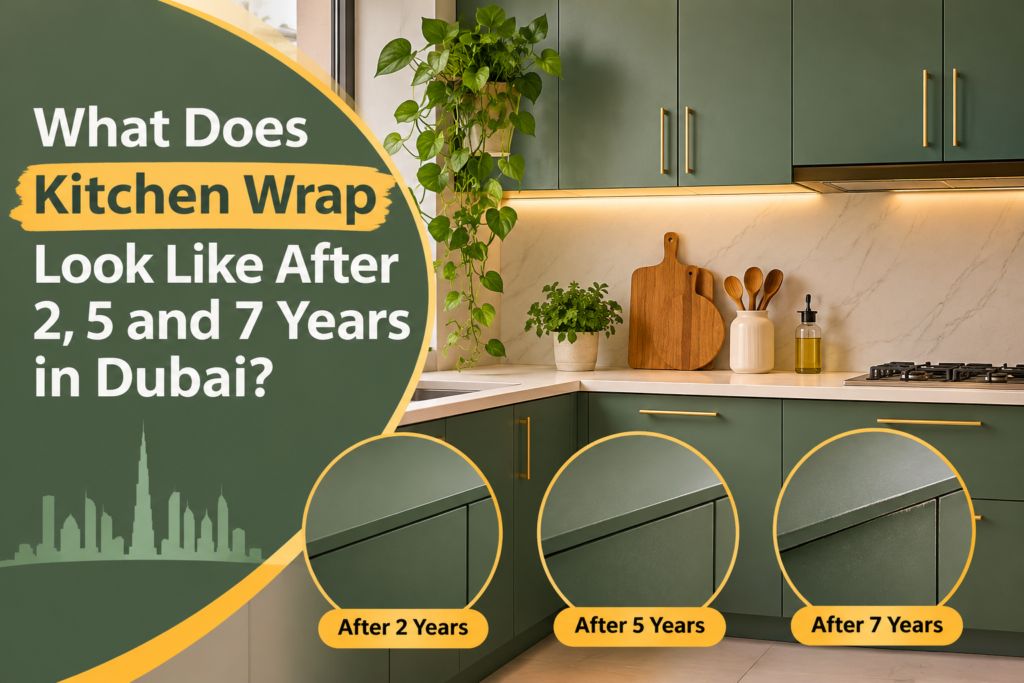
Picture the day your kitchen wrap goes on. The doors are smooth, the colour is crisp, and the tired old cabinets are gone. It feels like a brand new kitchen. Now fast forward five or six Dubai summers. What does it look like then?
That is the question most people forget to ask, and it is a good one. A wrap is not magic. It ages like anything else in a busy kitchen, and Dubai's heat, humidity and sunlight speed that up. In this guide, we walk through what to expect at 2, 5 and 7 years. We will show you what is perfectly normal and what is a sign to act. These are honest expectations, not guarantees, because every kitchen is different.
1. Short Answer: How Long Does Kitchen Wrap Last in Dubai?
A well-installed kitchen wrap often lasts around five to ten years. That is when quality architectural film is used. Cheaper decorative film can start to show problems within one to three years, so the material really matters.
Dubai adds a little extra pressure. Heat, steam and moisture all work on the adhesive over time. That means how the wrap is installed and how you look after it matter more than the brand name on the roll. If you are still deciding whether the idea suits your home, this overview of kitchen wrapping in Dubai explains what the service covers. Then come back here to see how it holds up in real life.
2. Why Dubai Is a Tougher Test for Kitchen Wrap
The same film can age very differently in a cooler, drier country. Four things about life in Dubai do most of the work. Let's go through them one at a time.
a. Heat and Constant Temperature Swings
Summer temperatures in the UAE regularly pass 40°C outdoors. Inside, your air conditioning keeps things cool. But cooking can push the heat near the hob far higher in a matter of minutes. Adhesive softens when it is hot and tightens again as it cools. That cycle repeats thousands of times over the years. The edges and corners feel it first, because they are the weakest point of any wrap.
b. Humidity, Especially Near the Coast
If you live near the coast, you already know how humid it gets. Moisture rarely harms the vinyl itself. The real worry is moisture reaching the board underneath through an unsealed edge. When that happens, MDF can swell and push the film up from behind. You will see it as a soft bubble or a raised line. This is a common story with water-damaged cabinet doors, and no film can hide swelling for long. Fixing the leak always comes before fixing the finish.
c. Sunlight and UV Exposure
Many Dubai kitchens have big windows or balcony doors. That is lovely for the room, but the sun can slowly fade colour on the doors it hits most. Over time, the sunny side of the kitchen may look slightly different from the shaded side. Dark shades and cheaper films show this earlier. Choosing a calmer shade helps, and these kitchen wrap colour trends show which finishes tend to stay fresh-looking.
d. Grease, Steam and Cleaning
Every time you fry, grill or boil, tiny amounts of grease and steam float through the room. They settle on cabinet fronts, especially the ones near the cooker. Grease attracts dust and slowly dulls the finish. Harsh cleaners can also wear away the top layer of the film. So how you clean matters almost as much as how you cook.
3. What Decides How a Kitchen Wrap Ages?
Two kitchens wrapped on the same day can look very different by year five. The first reason is the film itself. Architectural-grade film is built for interior surfaces and usually keeps its colour, texture and grip for longer than low-cost vinyl. The second reason is preparation. Even a small amount of grease, dust or old residue under the film can cause lifting and bubbling later on.
The condition of the board matters too. A swollen or chipped board will eventually show through the wrap, no matter how good the film is. Edge finishing is another big one, because most failures start at an edge or corner. Then there is the kitchen itself. A door beside the oven works much harder than a pantry door across the room, and a door facing a window sees more sun than one in the shade. Finally, your cleaning habits play a part. Gentle, regular cleaning protects the finish better than the occasional hard scrub.
The same factors apply to residential vinyl wrapping of wardrobes, doors and furniture. That is why film choice and preparation are always worth asking about before anything goes on.
4. How Different Film Grades Age
Film grade is the biggest single factor in how a wrap looks years later. The ranges below are commonly quoted guides, so treat them as rough. Your own kitchen may land on either side.
a. Budget Decorative Film
This film is thin and often made for short-term décor. It can start fading, curling or peeling within one to three years. Heat near the cooker usually shows the problem first. If a quote looks surprisingly cheap, the film is often where the savings come from.
b. Mid-Grade Furniture Film
This sits in the middle. It can look good for around three to five years in a normal kitchen. Gloss and colour hold up well when the surface has been prepared properly. It is a fair choice for lighter-use kitchens.
c. Architectural-Grade Film
This film is made for interior surfaces and is thicker, with a stronger adhesive. With good installation and care, it can last five years or more, and some kitchens reach seven to ten. It is the film most likely to still look good at the end of this guide.
5. What Changes First: Colour, Gloss, Texture and Adhesive
A wrap does not age all at once. Each part of the finish changes at its own pace, and knowing that helps you tell normal wear from a real problem.
a. Colour
Colour usually changes slowly. Light shades may turn a touch yellow, especially near the cooker. Darker shades may fade where the sun hits them. The change is often uneven, so one door can look a little different from its neighbour.
b. Gloss and Texture
Gloss tends to dull first around handles, where hands touch the door all day. Matte finishes can become slightly shiny in those same spots. Textured finishes can also smooth out after years of wiping. None of this means the wrap is failing. It simply shows that the kitchen is being used.
c. Adhesive
The adhesive ages out of sight, so you will not notice it until an edge starts to lift. Heat, steam and grease are its main enemies. Good preparation at installation protects it more than anything else you can do later.
6. What Kitchen Wrap Looks Like After 2 Years
a. The Overall Picture
At two years, a well-installed wrap should still look very close to day one. Colour, texture and gloss should be even across the kitchen. Most people would struggle to tell it from a brand new finish at normal viewing distance. If you are happy with how it looks, that is a great sign the film and installation were both solid.
b. What Is Normal at Year 2
Some small changes are completely normal by now. Glossy finishes may show very light micro-scratches, but usually only when strong light hits them at an angle. Doors near the cooking area may carry a faint film of grease or dust, which wipes away easily. Matte surfaces may look slightly polished around the handles. None of these need any action beyond regular cleaning.
c. Early Warning Signs at Year 2
Problems this early usually point to installation or film quality, not natural ageing. Keep an eye out for corners or edges that have started to lift, especially beside the oven. Small bubbles that keep returning after you press them down are another clue. So are seams or pattern joins that have begun to open, or doors in the sun that look noticeably different from the shaded ones.
The good news is that early lifting is usually a quick fix. It is also the most common story behind kitchen cabinet wrapping that goes wrong, and it nearly always begins at the corners and the hinge side of the door. Catch it now, and it stays small.
d. What to Do at Year 2
This is a good time to build simple habits. Press down any small lifted corners straight away and wipe the doors near the cooker once a week. Take a quick look under the sink for slow leaks. It also helps to take a photo of each door now, because those photos make it much easier to spot changes at year five.
7. What Kitchen Wrap Looks Like After 5 Years
a. The Overall Picture
Five years is the real test. By now the wrap has been through several Dubai summers and hundreds of cleaning sessions. A good installation will still look neat and cohesive. But it will not look brand new anymore, and a close look will show the difference. That is perfectly fine. It is simply what five years of family life looks like.
b. What Is Normal at Year 5
You will probably notice more fine scratches on glossy finishes, mostly on lower doors and drawers. Textured finishes may feel a little smoother around the handles and edges. Doors facing strong sun may have shifted slightly in colour, and white, cream and some wood grains show this most. You may also see minor edge wear on the corners you touch most often.
c. Where Problems Typically Appear by Year 5
i. Around the Cooker
Heat and grease make doors and panels near the hob the first to show wear. You may see discolouration, a sticky feel or a little lifting. A regular wipe-down makes a big difference here.
ii. Around the Sink and Dishwasher
Steam and splashes work at the edges and joints over time. Doors beside the dishwasher are the usual suspects, because hot steam escapes there at the end of every cycle.
iii. Light Colours and Cheaper Films
White and cream can pick up a slight yellow tone in kitchens with heavy frying or weak ventilation. Budget vinyl often looks clearly tired, cracked or peeling by this stage. If that is what you are seeing, it is more about the film than about you.
d. Horizontal Surfaces Age Differently
Worktops face knives, hot pans, spills and constant wiping. That is why they tend to show wear sooner than the cabinets around them. This is also why kitchen countertop wrapping works best as a lighter-duty upgrade, not a permanent surface. Using trivets and chopping boards from day one makes a real difference.
e. What to Do at Year 5
Give the kitchen a proper check. Look at every edge on every door and drawer, then deep clean with mild soap to lift built-up grease. Compare today's colour with your year 2 photos, and repair any lifted edges before they spread. It is also a good moment to think about whether your extractor fan is doing its job.
Planning a Kitchen Refresh?
See how Wrapstar approaches interior wrapping across Dubai homes, from kitchens to wardrobes and doors.
Explore Wrapstar8. What Kitchen Wrap Looks Like After 7 Years
a. The Overall Picture
Seven years is the upper end of what most homeowners should expect. It is realistic only with quality film, careful installation and good upkeep. A well-kept kitchen can still look clean and presentable at this age. But it will look like a surface that has been used for years, and that is okay. For a wider view, see how long vinyl wrap lasts in a kitchen.
b. What You Can Expect at Year 7
Wear around the handles and the lower edges of doors will be easy to see. Doors facing the sun may have faded enough that colour differences are clear. Edge lifting is often wider, usually near the cooker, sink or dishwasher. The finish may also look a little flatter, with less crisp texture and gloss than the original.
c. Why Some Kitchens Look Great at Year 7
Kitchens that age well share a few traits. They have quality film and a properly prepared surface. The board underneath stays sealed and dry. The cooking area is well ventilated, and the cleaning is gentle. Kitchens that struggle usually have the opposite: a hidden leak, poor ventilation or harsh chemicals. The wrap itself is rarely the only reason.
d. The Decision Point
Around this age, most owners face a choice. You can repair patches, re-wrap the kitchen or move to a different finish. The decision is much easier when you know what the surface underneath looks like. A professional check before you decide is well worth it.
e. What to Do at Year 7
Inspect the board under any lifted film and note which doors have faded most. Check the hinges and handles too, because loose hardware puts extra stress on the film. Then decide whether you want a spot repair or a full refresh.
9. Zone by Zone: Which Parts of the Kitchen Age First?
Not every surface ages at the same speed. Knowing the zones helps you predict problems before they show up.
a. Cabinet Doors and Drawer Fronts
Doors are used constantly but face less heat and moisture than other zones. They usually age well, with wear around handles and lower edges. Good results start with careful preparation, which is why it helps to understand how kitchen doors are wrapped.
b. Corners and Edges
Edges are the most vulnerable part of any wrap. Adhesive meets air, steam and handling there. Most failures begin at an edge and then spread across the door. Check edges regularly. It is your best early warning system.
c. The Area Behind the Hob
This is the harshest zone in any kitchen. Heat, splatter and steam all meet in one spot. For kitchen backsplash wrapping, heat resistance and distance from the flame matter even more than looks.
d. Sink and Dishwasher Areas
Repeated splashes reach edges and joints here. Hot steam escapes at the end of every dishwasher cycle. Wiping these doors dry after use stops slow moisture from building up.
10. Common Kitchen Wrap Problems and What Causes Them
Most wrap problems have a clear cause. Once you know the cause, the problem is much easier to prevent.
a. Bubbles
Bubbles come from trapped air or trapped moisture. Air bubbles usually appear soon after installation. Bubbles that show up years later often point to moisture in the board, so they deserve a closer look.
b. Peeling Edges
Edges peel when the adhesive loses its grip. Dust under the film, heat, steam and rough handling are the usual causes. Edges beside the oven tend to go first.
c. Yellowing
Light films can turn slightly yellow over time. Grease, smoke and strong sun all play a part. Poor ventilation makes it worse, so use your extractor fan while you cook.
d. Cracking and Shrinking
Low-grade film can shrink as it ages. It then pulls away from edges and cracks at the corners. This is rare with quality film, which is one more reason the grade matters.
e. Stains and Marks
Oil, turmeric, tea and coloured sauces can mark some finishes. Wiping spills quickly keeps them from setting. Light, matte surfaces show marks the most.
f. Wear Around Handles
Hands touch these spots every day. Skin oils and constant rubbing slowly wear the finish. This is normal, and it looks more obvious on dark and glossy films.
11. How Your Kitchen Layout Affects Wrap Ageing
The shape and setup of your kitchen change how the wrap ages. Two kitchens with the same film can end up looking very different.
a. Open-Plan Kitchens
Open kitchens usually get more light and better airflow. That helps steam and grease disperse. The trade-off is more sun, which can fade the finish on exposed doors.
b. Closed and Galley Kitchens
These kitchens trap steam and grease. Without a strong extractor fan, doors collect residue faster. The edges near the hob usually suffer most.
c. Kitchens With Large Windows
Doors facing the glass take the most UV. Blinds or light-filtering film can help a lot. It is worth checking now and then that those doors still match the rest.
d. Kitchens Used for Heavy Daily Cooking
If you fry, grill or simmer every day, your kitchen works harder. Weekly wiping matters more in this case, and so does a good extractor fan. A little routine care keeps the finish looking fresh much longer.
12. Kitchen Wrap Ageing Timeline at a Glance
Here is a quick summary of everything above. Use it as a simple reference.
| Age | What it typically looks like | What to watch for | Usual action |
|---|---|---|---|
| 2 years | Close to new, with very light surface marks | Early edge lifting, returning bubbles | Quick repair if caught early |
| 5 years | Presentable but visibly used | Wear near the cooker, sun fading, edge lifting | Inspect edges, deep clean, spot repair |
| 7 years | Aged but acceptable if well cared for | Widespread edge lift, fading, flatter texture | Decide between repair and re-wrap |
These are typical patterns, not promises. A hidden leak or a low-grade film can bring five-year symptoms forward to year two.
13. Normal Ageing vs a Real Problem
Not every flaw means your wrap has failed. Fine scratches that only show in direct light are normal. So is slight dulling around handles and a mild, even colour change on doors facing the sun. These are signs of a kitchen that is lived in.
Other signs need attention. These are the ones to look for:
- Edges or corners that lift and will not lie flat.
- Bubbles that keep coming back.
- Cracking, splitting or shrinking film.
- Soft or swollen areas that suggest moisture in the board.
- Sticky residue or yellowing near the cooker.
One lifted edge is usually a small repair. Lifting across many doors points to a deeper problem with the surface or the film.
Seeing Warning Signs in Your Kitchen?
Small problems get expensive when ignored. Tell the Wrapstar team what you are seeing and get a clear view of what your kitchen needs.
Book a Kitchen Check14. How to Help Your Kitchen Wrap Last Longer
The good news is that small habits can add years to the look of your wrap. None of them are hard, and most take only a minute or two.
a. Daily and Weekly Care
Wipe grease and splashes soon after cooking, using a soft cloth and mild dish soap in warm water. Dry the areas near the sink and dishwasher so moisture does not sit on the edges. Avoid abrasive pads, strong solvents and harsh degreasers, because they wear down the surface layer. For marks that will not budge, learn how to remove stains from vinyl wrap without harming the finish.
b. Protecting Against Heat and Sun
Use the extractor fan or open a window while you cook, so steam and grease do not settle on the doors. Keep air fryers, kettles and toasters away from cabinet fronts, or put a heat mat under them. If strong sun hits your cabinets for hours, blinds or light-filtering film can slow fading.
c. Fix Small Problems Early
Press down lifted edges quickly, before dust and grease get underneath. Fix leaks under the sink and around the dishwasher straight away. If you see bubbling or swelling, ask a professional to check it. Please do not cut or puncture the film yourself, because that can make things worse.
15. A Simple Yearly Inspection Checklist
A ten-minute check once a year can catch most problems early. Go door by door and look at the following:
- Corners and edges for lifting.
- Surfaces for bubbles, soft spots or swelling.
- Doors near the cooker for yellowing or sticky residue.
- Sun-facing doors for fading.
- The base of doors and drawers for signs of moisture.
If you find something, press down and seal minor lifting early. Photograph anything unusual and track it over time. Get swelling or soft spots checked quickly, and always fix a leak before you touch the wrap.
16. Mistakes That Shorten the Life of a Kitchen Wrap
Many early failures come from habits that are easy to avoid. The biggest one is using harsh degreasers, bleach or scouring pads. They strip the surface and speed up wear. Leaving wet cloths or dish racks against cabinet fronts is another, since constant dampness works on the edges.
Placing hot appliances close to doors also causes trouble, and so does skipping the extractor fan while frying. Many people ignore a small lifted edge or a slow leak under the sink, and both get worse with time. Finally, picking at a lifted corner makes it bigger. It is always better to press it down or get help. And wrapping over damaged or swollen boards will never end well.
17. Repair, Re-Wrap or Replace: What to Do When the Wrap Gets Old
Sooner or later, every wrap reaches a decision point. The right choice depends on how big the problem is and what is going on underneath.
a. When Repair Makes Sense
If the damage is limited to a few doors or small edge sections, and the board is sound, patching is often enough. Re-wrapping individual doors can restore a uniform look without redoing the whole kitchen. Just keep in mind that new film may look slightly different next to older film.
b. When Re-Wrapping the Whole Kitchen Is Better
Uneven fading, widespread edge lifting or an overall flat finish all suggest a full re-wrap. The board must be clean, dry and sound first, and the old film needs to come off properly. If you are comparing your options, this breakdown of wrapping, painting or replacing can help you decide.
c. When Replacement Is the Right Answer
Swollen, warped or rotten cabinet parts cannot be fixed with a wrap. The film simply follows whatever shape is underneath. In that case, replace the damaged parts first. A fresh finish can follow once the base is solid.
18. Is Kitchen Wrap Still Worth It If It Lasts 5 to 7 Years?
For many homes, yes. A wrap is not a lifetime finish. Think of it as a medium-term upgrade. The better question is whether five to seven good years suits your plans.
It makes the most sense when your cabinet boxes are solid and only the finish looks dated. It also suits people who want a new look without a full renovation, plan to stay for a few years, and are happy to re-wrap when the time comes. It is worth thinking twice if the boards are swollen or warped, if the kitchen has an unfixed leak, or if you expect a finish that never changes. Setting honest expectations is part of getting a good result. A wrap that ages as expected is a success, not a failure.
Want to See What a New Wrap Involves?
Learn how Wrapstar handles kitchen wrapping in Dubai, then compare it with the condition of your current finish.
View Kitchen Wrapping Service19. Frequently Asked Questions
a. Does kitchen wrap fade in Dubai's sun?
It can, especially on surfaces that get hours of direct sun. Quality film resists fading far better than budget vinyl. Blinds also help the cabinets nearest the window.
b. Will kitchen wrap peel in the heat?
Heat alone does not cause peeling on a proper installation. Heat combined with poor preparation, weak edges or moisture in the board can. Areas near the oven and hob are most at risk.
c. Can I clean wrapped cabinets with normal kitchen cleaners?
Mild dish soap and a soft cloth are safest. Strong solvents, bleach products and abrasive sponges can damage the finish.
d. How do I know if my wrap is failing or just getting old?
Fine scratches and slight dulling are normal. Lifting edges, repeating bubbles, cracking film and swollen areas are real problems. Get those looked at soon.
e. Is it better to re-wrap or replace after seven years?
If the cabinets underneath are solid, re-wrapping is often more practical. If the boards are damaged, replace those parts first.
f. Does a glossy wrap age better than a matte one?
Neither is always better. Gloss shows fine scratches and fingerprints more, while matte can look shiny where hands rub it. Film quality matters more than the finish.
g. Are dark or light colours better for Dubai kitchens?
Both have trade-offs. Dark colours show fading and dust more. Light colours show yellowing and stains more. Choose based on how much sun the kitchen gets and how you cook.
h. Can you fix one damaged door without redoing the kitchen?
Often yes. The new film may not match perfectly if the rest has aged. A small colour difference is common after several years.
i. Does kitchen wrap damage cabinets when removed?
Good film on sound boards usually comes off cleanly. Old, brittle film on weak boards is harder. Results depend on age, heat and the surface underneath.
20. Final Thoughts: Plan for Year 7, Not Just Day One
A kitchen wrap in Dubai can look good for many years. It simply needs the right film, careful preparation and a little regular care. Expect a near-new look at two years. Expect a clearly used but good-looking finish at five. Expect a decision point around seven.
The kitchens that age best are the ones where problems were prevented, not patched. A little attention each year goes a long way.
Ready to Get Your Kitchen Assessed?
Whether you are planning a new wrap or worried about an old one, the Wrapstar team can tell you what your kitchen needs before you commit.
Contact Wrapstar